
The autoclave switches on again. That is welcome news—but it does not, by itself, establish that the facility can resume processing instruments. A clinic commissioning a repair in Uganda should agree both the technical work and the evidence required before return to routine use.
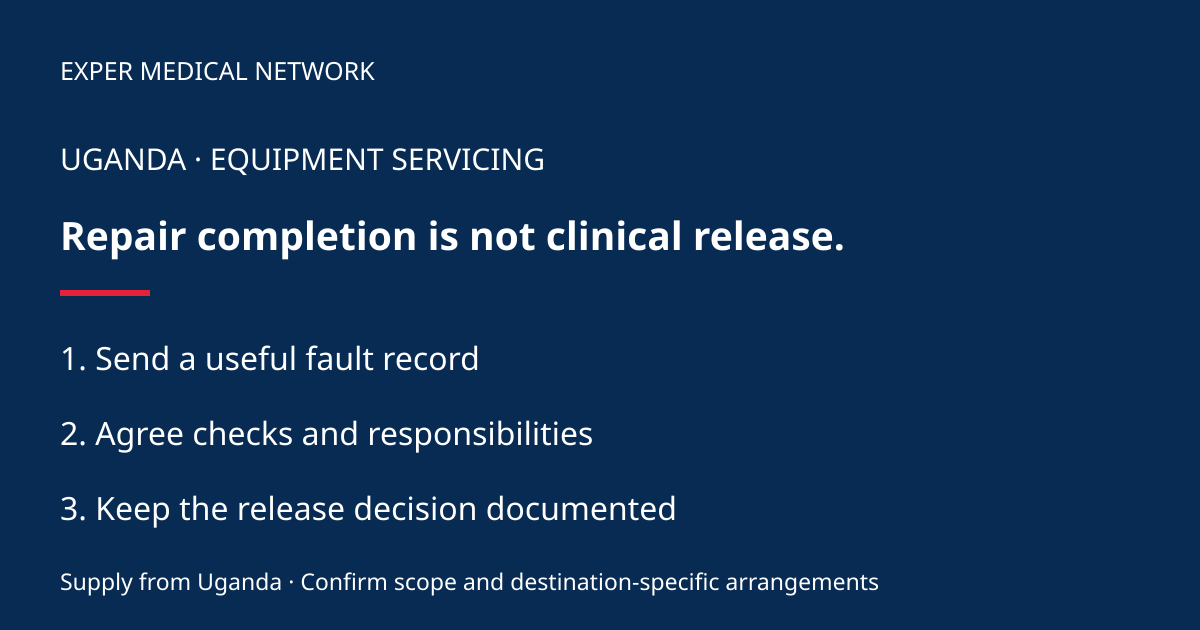
Send a fault record, not just “not working”
Record the manufacturer, model, serial number, displayed error and when the fault occurred. Include available cycle records, maintenance history and a description of recent changes. Send photographs of accessible labels or displays without opening covers or exposing confidential information.
Tell the service provider whether the issue followed relocation, an interrupted cycle or earlier repair. Do not diagnose a failed component from an error code alone. Ask the provider what further information is needed and whether assessment requires a visit or transport to a workshop.
Separate assessment from an authorised repair
Ask for a written scope covering diagnosis, proposed parts, labour, transport and any tests included. Clarify what requires further approval after inspection. Request component references and the reason for any proposed substitution.
For illustration, an initial assessment fee may not include replacement parts or the later verification work. Comparing only the first quoted amount can therefore be misleading. Use our service-agreement checklist to identify exclusions before work begins.
Define the evidence needed for release
Have the biomedical and infection-prevention leads agree the verification plan using manufacturer instructions and the facility’s applicable requirements. CDC guidance identifies installation, relocation, major repair and sterilization failure as situations requiring sterilization-cycle verification, including biological and chemical indicator testing before routine use. Its guidance also distinguishes mechanical, chemical and biological monitoring.
That is a reason to plan verification—not a universal test recipe for every machine or repair. The responsible team must select the applicable process and interpret the results. A completed repair invoice, a warm chamber or a colour-changing strip alone is not a substitute for that decision.
Allocate the materials and responsibilities
Record who supplies the required indicators and other test materials, who carries out technical checks, who reviews results and who authorises return to use. Ask how the records will identify the instrument, work performed, test conditions and unresolved issues.
Plan service continuity with the clinical team while the machine remains unavailable. Do not assume a loan unit, outsourced processing or a fixed repair time is included. Any alternative arrangement needs its own confirmed scope and suitability assessment.
Close the job with an equipment record
Request a service report identifying the fault findings, parts replaced, work completed and test results supplied. Retain it with the release decision and the next maintenance actions. Where evidence is incomplete, record what remains outstanding rather than allowing a verbal handover to become an accidental approval.
Send Exper the equipment details, fault record and exact Uganda location to enquire about an assessment and support scope. Browse dental equipment if replacement is being considered; the autoclave buying guide addresses that separate decision. Confirm service availability, charges and responsibilities for your specific machine.
Technical reference reviewed 12 November 2026: CDC sterilizing practices. This supports planning and is not presented as Uganda’s regulatory requirements or a do-it-yourself repair procedure.
Contact +256 756 789 821 or info.brandexper@gmail.com with your destination, equipment list and quantities. Exper requires 100% payment before delivery. Request current availability and written terms for your order.