The highest output number on a dental curing-light advert is not automatically the best purchase. For a Ugandan dental practice, the useful question is whether the offered light suits the materials, procedures and working positions the dentist actually uses.
Start with the materials already in the clinic
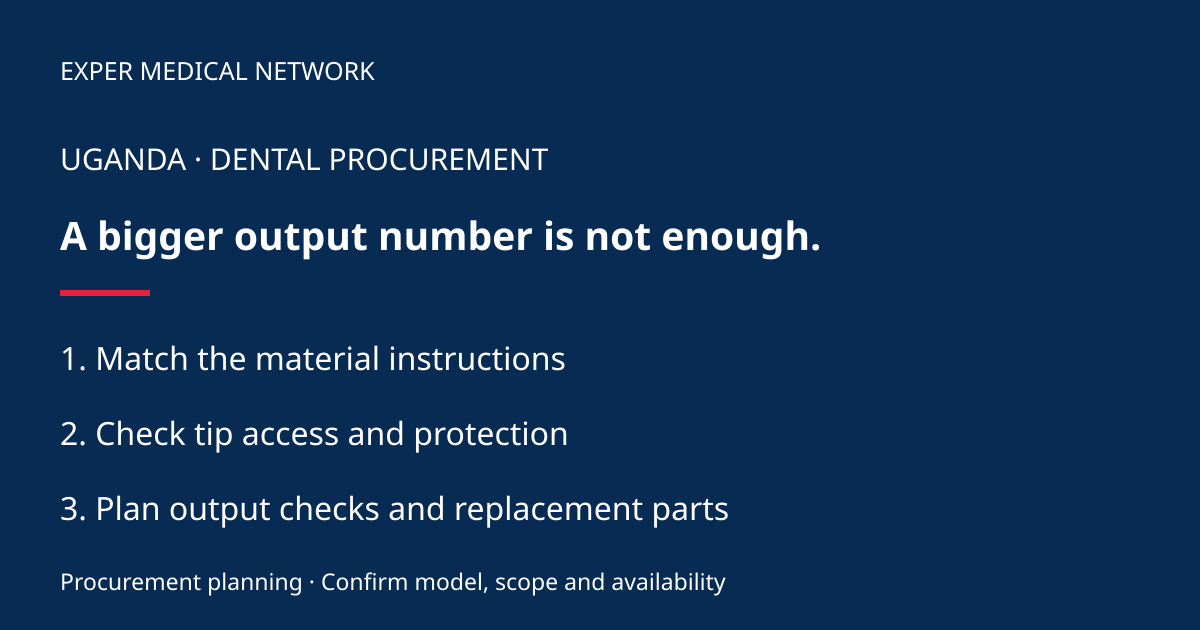
List the composite, adhesive, cement and other light-cured products used in the practice, including their exact versions. Ask the dentist to compare their instructions with the proposed light’s documented wavelength range and operating modes. Avoid a blanket “works with all composites” assurance without supporting documentation.
The American Dental Association explains that effective curing depends on appropriate wavelength and delivered light energy, with tip distance, angle and diameter among the relevant variables. An advertised irradiance value alone therefore does not establish suitability. Follow the material and equipment instructions rather than inventing a shorter curing time from a larger number.
Request a configuration-specific demonstration
Have the dentist assess access and handling on an appropriate training model, not by experimenting on patients. Check whether the supplied tip reaches the intended areas comfortably, how modes are selected and whether the timer indications are clear. Ask which tip is included and which alternatives cost extra.
As an illustrative purchasing problem, a clinic can compare one quote with a complete handpiece, tip and charger against another for the handpiece alone. Itemising the package prevents that mismatch. A photograph showing several tips does not establish that all are supplied.
Include protection and care in the order
ADA guidance highlights blue-light eye hazards and the importance of suitable protection, along with infection control and heat considerations. Ask for the protection specified for the offered unit and have the clinical team approve the working protocol. Ordinary tinted eyewear should not be assumed suitable.
Request the manufacturer’s instructions for barriers, cleaning and any reprocessing of removable components. Identify the associated supplies in the quote. Do not assume a removable tip or the entire handpiece can be sterilised by the same method as another model.
Agree how performance will be followed
Ask what equipment and method the manufacturer recommends for routine output checks, how results are recorded and when the unit should be referred for assessment. If a measuring device is included, identify its model and intended compatibility. A reading must be interpreted using the relevant instructions, not treated as a universal guarantee of clinical curing.
Record replacement-tip, battery and charger references, warranty exclusions and the fault-reporting process. Confirm whether technical assessment is available for the specific model and what transport or inspection charges may apply. No fixed repair turnaround should be assumed unless agreed in writing.
Send a material-led enquiry
Send Exper your location in Uganda, the material references the dentist wants to use, preferred configuration and quantity. Visit our dental equipment page and request a documented quotation with accessories and exclusions. If opening a practice, read what to buy first for a small dental clinic for the broader purchasing sequence.
Reference reviewed 13 November 2026: American Dental Association: Dental Curing Lights. This is procurement guidance, not a clinical curing protocol or a statement of current Exper stock.
Contact +256 756 789 821 or info.brandexper@gmail.com with your destination, equipment list and quantities. Exper requires 100% payment before delivery. Request current availability and written terms for your order.